
informational 6 min read
Sacred and Profane Love: Titian's Painting at the Borghese
Updated October 27, 2026
Sacred and Profane Love is an oil painting on canvas by Titian, made around 1514-16 and bought by Cardinal Scipione Borghese, probably in 1608. It shows two women who look like the same person, one richly dressed and one nearly nude, sitting on either side of a carved stone basin while a winged boy stirs the water. It measures 118 x 279 cm and hangs in Room 20 of the Borghese Gallery in Rome. What it means is still debated.
The two women
Two women sit on the rim of an ancient-looking sarcophagus that has been turned into a fountain or water trough.
- On the left, a woman in a rich white dress looks toward the viewer. She wears a belt and a crown of myrtle, a plant sacred to Venus and worn by brides. Her hand rests by a metal bowl.
- On the right, a woman with the same face is nude except for a white cloth and a red cloak over one shoulder. She holds up a small vessel with a flame, which the museum calls a lamp, a sign of burning love and an attribute of Venus.
- In the middle, a winged child, Cupid or a putto, leans over the rim and stirs the water with his hand.
The landscape splits in two as well. Behind the clothed woman, a road climbs to a fortified town on a hill, with two rabbits nearby. Behind the nude woman, the land falls away to a village with a church tower by a lake, horsemen hunting a hare, and a shepherd with his flock.
The carved scenes on the front of the basin have no agreed reading. One of the coats of arms on it belongs to Niccolò Aurelio, the man who most likely ordered the picture.
Readings of the painting
A wedding picture. The museum’s catalogue says the painting was most likely commissioned in 1515-16 by Niccolò Aurelio, secretary to Venice’s Council of Ten, for his marriage to Laura Bagarotto. Their arms appear on the front of the basin and inside the silver bowl. The belt and myrtle crown of the seated woman are attributes of married love. This is the reading the museum favours today: the painting praises the perfect bride, splendidly dressed in her public role and, at the same time, nude and full of true love for her husband in private.
Two Venuses. Erwin Panofsky read the two women as the “twin Venuses” of Renaissance Neoplatonism: the clothed one as the earthly Venus and the nude one as the heavenly Venus, with Cupid joining heaven and earth. Wikipedia calls this the most widely accepted interpretation.
Other readings. Edgar Wind saw Beauty (clothed) and Pleasure (nude). Others have linked the scene to Polia and Venus in the 1499 Venetian romance Hypnerotomachia Poliphili, or to Venus and Medea in Valerius Flaccus.
Which is sacred? The title only appears in a Borghese inventory of 1693, as Amor Divino e Amor Profano. By the 20th century scholars generally agreed that, against first impressions, the nude figure would be the “sacred” love and the clothed one the “profane” (earthly) one. Some think the title has nothing to do with Titian’s idea.
A dating note: Wikipedia gives 1514. The museum’s catalogue dates it 1515-1516, at the end of Titian’s early period.
The Rothschild offer
How the painting reached the Borghese is unclear. The usual account, adopted by most scholars, says Cardinal Paolo Emilio Sfondrati sold it to Scipione Borghese on 20 July 1608 with 71 other paintings. The museum notes that the sale document is weak evidence and that the painting is certain to be in the collection only by around 1620, when Anthony van Dyck sketched it there.
It stayed in the family for almost three centuries. Writing in the International Herald Tribune in 1995, the journalist Roderick Conway Morris reported that the Rothschilds offered the Borghese 4,000,000 lire for this one painting. That was more than the whole collection fetched when the heirs agreed to sell it to the Italian state. He also reported that Prince Camillo Borghese offered, in vain, to give the entire collection to the nation for free if the family could keep this single painting and the right to export it. The state bought the collection in 1902, and the painting with it.
Where it hangs
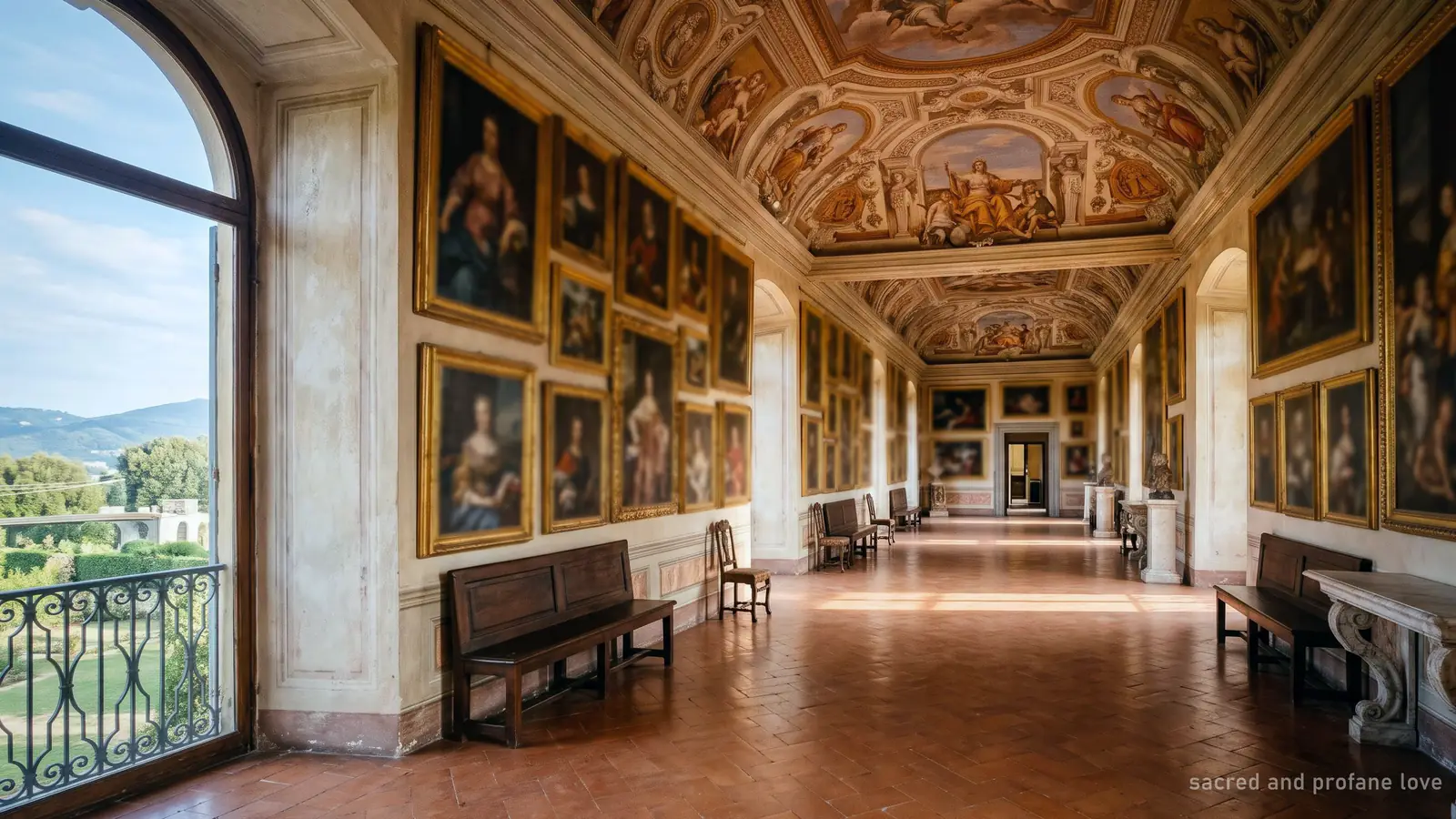
The painting is in Room 20, the Psyche Room, the last room of the visit on the first floor. Pietro Antonio Novelli painted the story of Cupid and Psyche on the vault. The room is dedicated to Venetian Renaissance painting. With Sacred and Profane Love, it holds three more Titians: Venus Blindfolding Cupid, Saint Dominic and Christ at the Column. It also has Antonello da Messina’s Portrait of a Man, a Madonna and Child by Giovanni Bellini, Lorenzo Lotto’s signed and dated 1508 Madonna and Child with Saints, and Paolo Veronese’s Preaching of Saint John the Baptist.
The autumn 2026 Titian exhibition
The museum’s Visit page said in October 2026 that Room XX would stay closed until 16 October 2026 to install the exhibition “Titian. Dialogues between Sacred and Profane”. Rome’s tourism board, Turismo Roma, lists the show as Tiziano. Dialoghi tra Sacro e Profano, curated by Maria Giovanna Sarti, from 20 October to 8 December 2026. It brings Titian’s Annunciation from Treviso Cathedral to Rome to hang beside the Borghese Titians. Finestre sull’Arte reports that the loan was possible because the cathedral’s Malchiostro Chapel is being restored. The museum’s own rules say ticket prices may rise during temporary exhibitions, which are part of the same visit and ticket.
It is not the first such show. In 2022 the same curator hung Titian’s late Nymph and Shepherd, lent by Vienna’s Kunsthistorisches Museum, in the same room.
Seeing it on your visit
Room 20 is on the first floor, the Pinacoteca, with the paintings. The Borghese Gallery works on timed two-hour slots, so leave enough of your slot for the upstairs rooms after the sculpture on the ground floor. The 5.45 pm slot lasts only 1 hour 15 minutes.
The official ticket costs €18 (€16 + €2 booking fee), about $20, and cannot be refunded or changed. During the Titian exhibition, check the price for your date on the ticket price page. The guided tour starts from $55 per person, with free cancellation up to 24 hours before on the listing. All options are on the tickets and tours page.
To plan the rest of the first floor, from Raphael’s Deposition in Room 9 to the Titians, see the paintings on the Borghese Gallery’s first floor on our masterpieces page.
Check prices & dates
Book your tickets in advance: popular time slots sell out.
Book Borghese Tickets
From$44per person
Check availability- Free cancellation up to 24h on every ticket listed
- Reserve now, pay later
- Official price shown alongside
Frequently asked questions
Who are the two women in Sacred and Profane Love?
Scholars still disagree. Most now read the painting as a wedding picture: the clothed woman is the bride, and the nude woman is either Venus or the bride's love shown in its private, ardent form. Erwin Panofsky read them as the earthly and the heavenly Venus.
Which figure is sacred and which is profane?
Against first impressions, the 20th-century reading made the clothed woman profane (earthly) love and the nude woman sacred (heavenly) love. The title itself is first recorded only in a 1693 inventory, so it may not be Titian's idea.
Where is Sacred and Profane Love?
In Room 20, the Psyche Room, on the first floor of the Borghese Gallery in Rome, with three other paintings by Titian.
Is the Titian room open in autumn 2026?
The museum closed Room XX until 16 October 2026 to install the exhibition 'Titian. Dialogues between Sacred and Profane'. Listings give the exhibition dates as 20 October to 8 December 2026. Ticket prices may rise during temporary exhibitions.
Sources