
informational 5 min read
Bernini's David: The Sculpture, the Face and Where It Is
Updated October 27, 2026
Bernini’s David is a life-size marble statue, 170 cm high, carved by Gian Lorenzo Bernini in 1623 and 1624 for Cardinal Scipione Borghese. It shows the biblical shepherd David at the moment he swings his sling to throw the stone that will bring down Goliath. It stands in the middle of Room 2 of the Borghese Gallery in Rome. It is the only biblical subject among the statues Bernini made for the cardinal.
The moment Bernini chose
The story is from the First Book of Samuel. Goliath, champion of the Philistines, challenges the army of King Saul to settle the war in single combat. The young shepherd David accepts and kills him with a stone from his sling.
Bernini shows David a split second before the stone flies. His body is twisted, his arms are pulled tight on the sling and his face is set in effort. On the ground between his legs lie two objects:
- Saul’s armour. The king gave it to David, who left it behind because it was too heavy. It also works as a third support that balances the daring pose.
- A harp. It is David’s usual attribute, since he will sing a psalm after the victory. Here it ends in an eagle’s head, one of the heraldic animals of the Borghese family. The museum reads it as a nod to the patron at a time when the family’s fortunes depended on the new pope.
The commission did not start with Borghese. In March 1623, Cardinal Montalto asked Bernini for a David for his own villa. Montalto died that June, and Scipione Borghese took over the commission. Bernini put down Apollo and Daphne to carve it, and his biographer Filippo Baldinucci says he finished it in seven months.
Baroque vs Renaissance: Bernini vs Michelangelo
The best-known David before Bernini’s is Michelangelo’s colossal marble in Florence, carved from 1501 to 1504. The two take opposite approaches.
| Michelangelo’s David | Bernini’s David | |
|---|---|---|
| Date | 1501-1504 | 1623-1624 |
| Moment | Before the fight: standing, watching the enemy | During the fight: the throw itself |
| Pose | Standing, steady on his legs | Twisting, off balance, mid-movement |
| Space | Self-contained, seen from the front | Reaches out; the viewer stands where Goliath would be |
The museum’s catalogue says it plainly: Michelangelo showed David in the traditional standing pose, steady on his legs, preparing to face the enemy. Bernini changed the image and showed the hero in action, his body unbalanced and twisting. Wikipedia adds that throwing figures were very rare in sculpture after antiquity. Earlier Davids by Donatello and Verrocchio show the victory afterwards.
The statue also reaches into the viewer’s space. David’s toes go over the edge of the plinth. Bernini’s intended viewpoint put the visitor directly in front, in Goliath’s place, so you “see” the throw coming at you. Scholars name possible models: Annibale Carracci’s Polyphemus throwing a rock on the Farnese Palace ceiling, and the ancient Borghese Gladiator, which was then in the same villa and is now in the Louvre.
Size, face and the self-portrait story
Size and material: 170 cm high, in white marble that the museum’s catalogue lists as probably Carrara. That is life-size, not colossal.
The face: David frowns hard and bites his lower lip. Wikipedia notes that this kind of extreme emotion was new in sculpture. It also follows a convention of the time for a warrior’s head, the “lion’s face” with a receding forehead, heavy brows and a curved nose.
The self-portrait story: According to the early sources, the face is Bernini’s own. Baldinucci says Cardinal Maffeo Barberini liked to hold the mirror in which the young sculptor studied his own face. Bernini’s son Domenico tells the same story. Barberini was elected Pope Urban VIII in 1623, before the statue was finished. The museum repeats the story as what the sources say.
The back: David was made to stand against a wall. His back was left unfinished, and part of his left heel was missing until a modern restoration completed it.
Where it is in the gallery
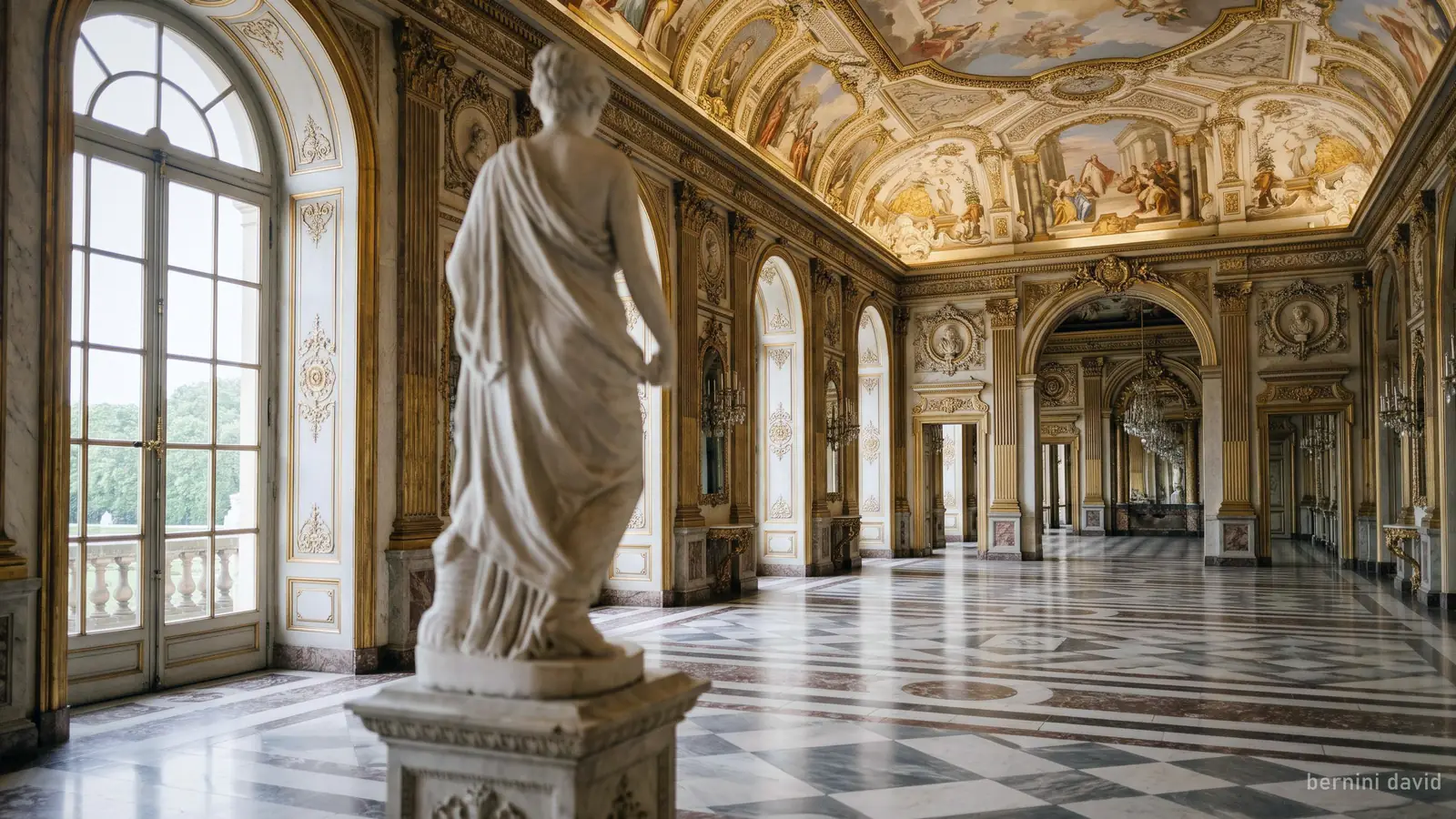
Bernini’s David stands in the middle of Room 2, now called the David Room, on the ground floor. The room used to be called the Room of the Sun, after the Fall of Phaethon painted on the ceiling by Francesco Caccianiga between 1775 and 1777.
The statue has moved several times. It first stood against a wall in what is now Room 1. In 1821 it went to Room 3, then to the upstairs loggia, then to the main hall, and finally to the centre of Room 2.
Look at the walls too. Room 2 has Battistello Caracciolo’s painting David with the Head of Goliath, the same hero after the fight. Caravaggio’s David with the Head of Goliath is in Room 8, the Silenus Room. That makes three Davids in one visit.
Seeing it on your visit
The Borghese Gallery works on timed two-hour slots. Entry is at the start of each hour, booking is required for every ticket, and the 5.45 pm slot lasts only 1 hour 15 minutes. The David is on the ground floor between Canova’s Pauline Bonaparte in Room 1 and Apollo and Daphne in Room 3.
The official ticket costs €18 (€16 + €2 booking fee), about $20. It is non-refundable. A guided tour from $55 per person or a reserved-slot ticket from $46 are the alternatives; both listings show free cancellation up to 24 hours before. Compare them all on the tickets and tours page.
To see where the David sits among the other works, read our guide to the Bernini sculptures in the Borghese Gallery.
Check prices & dates
Book your tickets in advance: popular time slots sell out.
Book Borghese Tickets
From$44per person
Check availability- Free cancellation up to 24h on every ticket listed
- Reserve now, pay later
- Official price shown alongside
Frequently asked questions
When did Bernini make his David?
In 1623 and 1624. He paused work on Apollo and Daphne to carve it, and his early biographer Filippo Baldinucci says he finished it in seven months.
How tall is Bernini's David?
170 cm, according to the Borghese Gallery's catalogue: a life-size figure in white marble, probably from Carrara.
Is Bernini's David a self-portrait?
The early sources say so. Baldinucci wrote that Cardinal Maffeo Barberini, soon to be Pope Urban VIII, held the mirror while Bernini carved his own features into David's face. The museum reports this as what the sources say.
Where is Bernini's David?
In the middle of Room 2 of the Borghese Gallery in Rome, on the ground floor. The room is now called the David Room.
Sources