
informational 7 min read
Apollo and Daphne by Bernini: The Myth and the Sculpture
Updated October 27, 2026
Apollo and Daphne is a life-size marble group by Gian Lorenzo Bernini, carved between 1622 and 1625 for Cardinal Scipione Borghese. It shows the moment in Ovid’s Metamorphoses when the nymph Daphne, chased by the god Apollo, turns into a laurel tree. It is 243 cm high, made of Carrara marble, and it still stands in the villa it was made for: Room 3 of the Borghese Gallery in Rome, which is named after it.
The myth in Ovid’s Metamorphoses
The story is in Book I of Ovid’s Metamorphoses, the Latin poem of transformations Ovid wrote at the start of the first century AD. It is a Roman telling of a Greek myth: Apollo is the god of the sun, music and poetry, and Daphne is a nymph, the daughter of the river god Peneus and a follower of Diana, goddess of the hunt.
Cupid starts it. Proud of his bow, Apollo mocks the little god’s arrows, and Cupid takes revenge with two shots. The Borghese Gallery’s own catalogue sums it up: a gold arrow makes Apollo fall in love with Daphne, and a lead arrow makes Daphne refuse all love. Apollo chases her. She runs until her strength gives out, then prays to her father to change the body that drew the god’s desire.
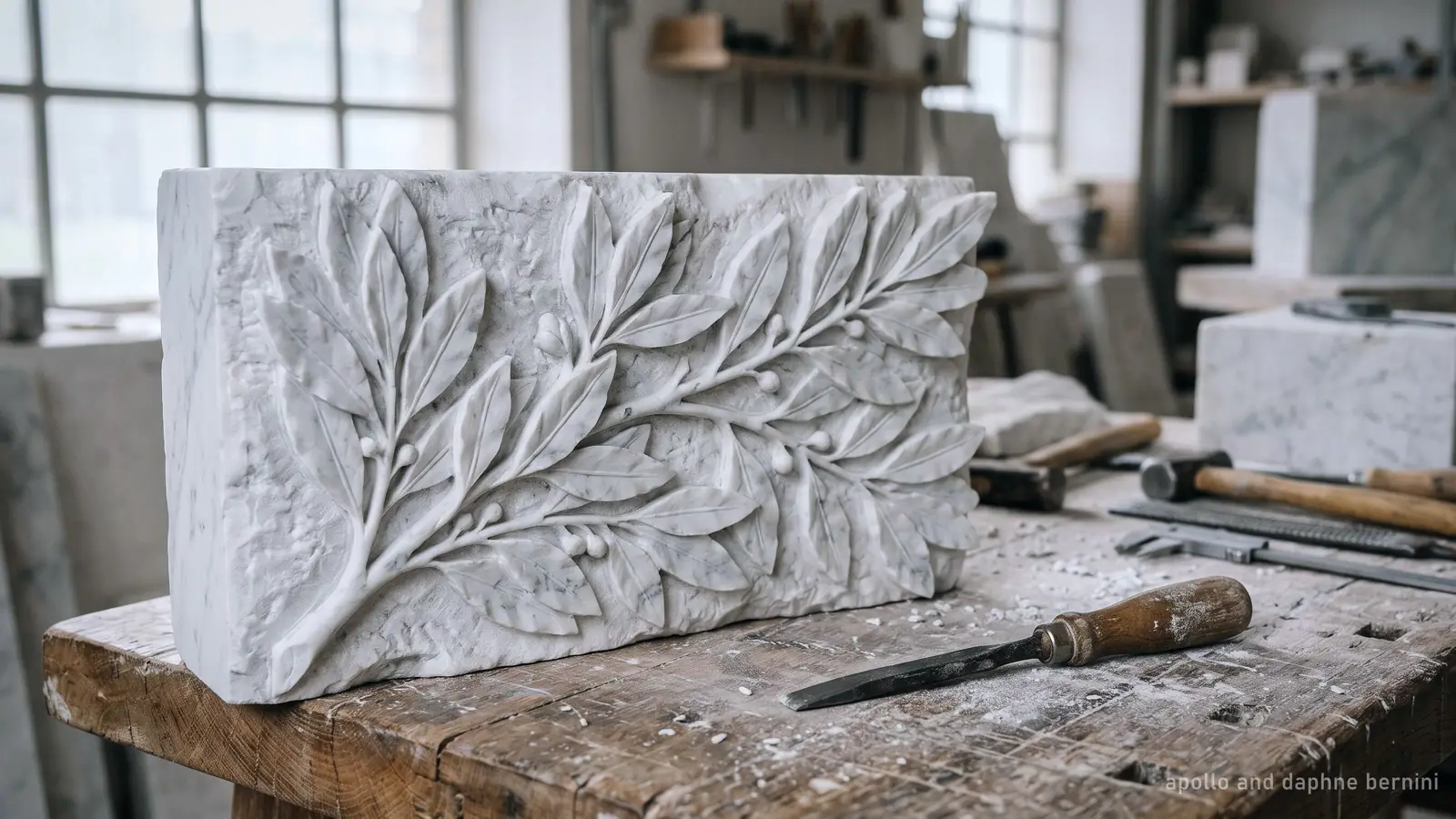
Her prayer is answered at once. In Ovid’s words, bark closes around her chest, her hair becomes leaves, her arms become branches and her feet take root. Apollo still loves the tree. He declares the laurel his own: it will crown his hair, his lyre and the Roman generals in their triumphs, and it will stay green forever. That is why the laurel wreath became the sign of poets and victors.
How Bernini carved the transformation
Bernini chose the single second in which the change happens. Apollo has just caught up with Daphne. His right foot is on the ground and his left is still in the air, his cloak flying behind him from the run. His left hand reaches for her body and touches bark instead. Daphne’s arms shoot upward and her face turns back toward him, but her toes are already roots and her fingers and hair are already laurel leaves.
The museum’s records let you follow the job step by step:
- 2 August 1622: the marble block is bought.
- 1623: work stops for about a year while Bernini carves his David for the same patron.
- 1624: payments to the sculptor start again.
- By March 1625: the base, by the stone carver Agostino Radi, is done.
- August 1625: the group is installed in the villa.
- 24 November 1625: final payment. Bernini received 1,000 scudi in total.
It was the last of the great marble groups Bernini made for Scipione Borghese. It came after The Rape of Proserpina, which the cardinal gave away in 1622, and around the David.
The catalogue credits the effect to plain tools used with great skill. A drill opens the gaps between the fingers turning into leaves and the toes turning into roots, and it frees the loose locks of hair. A toothed chisel gives the bark its texture. Different levels of polish separate skin from cloth. During the 1997 restoration, conservators found that Bernini had wrapped the thinnest parts in pads of plaster to protect them from vibration while he worked on the rest, then removed the pads at the end.
Bernini did not work alone. The 17th-century writer Giovanni Battista Passeri credited some details to Bernini’s gifted assistant Giuliano Finelli. After studying the sculpture closely, the museum now describes Finelli’s part as general workshop help rather than authorship of particular passages.
What the sculpture means
The group had to justify a naked pagan myth in a cardinal’s house, and the base does that. It carries a cartouche shaped like a dragon skin with two Latin lines by Cardinal Maffeo Barberini, the future Pope Urban VIII. The first reads “Quisquis amans sequitur fugitivae gaudia formae”: whoever, loving, pursues the pleasures of fleeting beauty. The second line ends with that lover’s hands full of leaves and bitter berries. By the late 1400s, Daphne already stood for virtue that escapes temptation and stays pure, evergreen like the laurel.
The museum’s catalogue also reads a second message in it: Apollo and the laurel celebrate the cardinal himself and his new villa as a place of art and pleasure.
Bernini also borrowed from famous models. His Apollo copies the ancient Apollo Belvedere in the Vatican down to the sandals. The catalogue also points to Annibale Carracci’s fleeing Acis on the Farnese Palace ceiling. Daphne’s face recalls the screaming mother in Guido Reni’s Massacre of the Innocents. Reni was Scipione Borghese’s favourite painter.
Details to look for: fingers, bark and the inscription
When you stand in front of it, look for these:
- Daphne’s fingers. Each one ends in thin, separated laurel leaves.
- Apollo’s hand. It rests on Daphne’s hip just where the bark is closing over her skin.
- Her toes. They are turning into roots that grip the ground.
- The two cartouches. The dragon-skin cartouche with Barberini’s couplet has been there since 1625. A second one, shaped like an eagle with lines from Ovid, was added in the 1780s.
- The unfinished back. Some surfaces Bernini never expected anyone to see were left rough. They are visible now because the group stands in the middle of the room.
- The ceiling. Pietro Angeletti’s painting in the vault, from the 1780s, shows Cupid striking Apollo and Daphne with his two arrows, with the transformation in the centre.
Where it stands in the Borghese Gallery
Apollo and Daphne is in Room 3, the Apollo and Daphne Room, on the ground floor with the sculpture collection. Bernini placed it against the wall next to the chapel. Visitors came in along Apollo’s right side, so they read the chase first and reached Daphne’s changing body last.
At the end of the 18th century, Prince Marcantonio IV Borghese had the villa redecorated under the architect Antonio Asprucci. The most important statues were placed in the middle of their rooms. Apollo and Daphne was the only modern work moved this way, and it was turned to its present position after advice from the sculptor Vincenzo Pacetti in 1785. That is when the second cartouche was added. The room’s decoration, from 1780 to 1785, was planned around the group.
The move cost the group Bernini’s intended viewpoint, but it is why you can now walk all the way around it. The room has two other Apollo works: a colossal marble head of the god from the 2nd century BC, and Dosso Dossi’s painting Apollo and Daphne. Dossi’s Melissa hangs there too.
The group has stayed in the villa since 1625. The Italian state bought it with the rest of the Borghese collection in 1902.
Seeing it on your visit
Every visit to the Borghese Gallery runs on a timed two-hour slot. Entry is on the hour, up to 180 people per slot, and booking is required even for free tickets. Rooms 1 to 4 are all on the ground floor, so you can see Canova’s Pauline Bonaparte, Bernini’s David and Apollo and Daphne close together. Photos are allowed without flash or tripods.
The official ticket costs €18 (€16 + €2 booking fee), about $20. It is non-refundable and cannot be changed. See the ticket price page for the reduced and free categories. If you want someone to explain the sculptures in the room, the guided tour starts from $55 per person and includes a reserved slot. The audio guide ticket starts from $44. Both show free cancellation up to 24 hours before on their listings. All options are on the tickets and tours page.
Apollo and Daphne is one of a short list of works most visitors come for. See the Borghese Gallery masterpieces for the others and where they hang.
Check prices & dates
Book your tickets in advance: popular time slots sell out.
Book Borghese Tickets
From$44per person
Check availability- Free cancellation up to 24h on every ticket listed
- Reserve now, pay later
- Official price shown alongside
Frequently asked questions
Who sculpted Apollo and Daphne?
Gian Lorenzo Bernini (1598-1680) carved it for Cardinal Scipione Borghese between 1622 and 1625, when he was in his twenties. His assistant Giuliano Finelli may have worked on some of the leaves and hair; the museum now treats that as general workshop help.
What is Apollo and Daphne made of?
Carrara marble. The group is 243 cm high, according to the Borghese Gallery's catalogue, and sits on a base made by Agostino Radi in 1625.
Where is Bernini's Apollo and Daphne?
In Room 3 of the Borghese Gallery in Rome, the Apollo and Daphne Room on the ground floor. It has been in the villa since 1625 and has never left the collection.
What is the meaning of Apollo and Daphne?
It shows Ovid's myth of a nymph who escapes a god by turning into a laurel tree. A Latin couplet by Maffeo Barberini on the base turns it into a moral lesson: whoever chases fleeting beauty ends up with leaves and bitter berries in his hands.
Can you walk all the way around Apollo and Daphne?
Yes. Bernini placed it against a wall, but it was moved to the middle of Room 3 at the end of the 18th century, so today you can see it from every side.
Sources