
informational 5 min read
Pauline Bonaparte as Venus Victrix: Canova's Statue
Updated October 27, 2026
Pauline Bonaparte as Venus Victrix is a marble portrait of Napoleon’s sister by Antonio Canova, carved in Rome between 1804 and 1808. Pauline reclines half-nude on a couch, holding the golden apple that makes her Venus, winner of the Judgement of Paris. Her husband, Prince Camillo Borghese, commissioned it. It stands in Room 1 of the Borghese Gallery, which is named the Pauline Room after it.
Who Pauline Bonaparte was
Pauline Bonaparte (1780-1825) was born Maria Paola Buonaparte in Ajaccio, Corsica, the sixth child of Carlo Buonaparte and Letizia Ramolino. Her elder brother was Napoleon, and she is said to have been his favourite sister.
Her life, in short:
- 1797: Napoleon marries her to General Charles Leclerc. Their son Dermide is born in 1798.
- 1801-1802: she goes with Leclerc to Saint-Domingue (today’s Haiti), where he dies of fever in November 1802.
- 1803: she marries Camillo Borghese, 6th Prince of Sulmona, a Roman noble. Napoleon, then First Consul, wanted the tie to an old Roman family.
- 1804: her only child, Dermide, dies in Frascati.
- 1814: after Napoleon’s fall she is the only one of his siblings to visit him in exile on Elba.
- 1825: she dies in Florence, three months after reconciling with Camillo.
She had a reputation for scandal in Paris and Rome, which is part of why the statue caused such a stir.
The commission and the scandal
Camillo Borghese commissioned the portrait from Canova in 1804, and it was paid for with 6,000 scudi on 15 May 1808, according to the museum. The marriage was not a happy one, but Camillo went to the most famous sculptor of the day.
Canova portrayed her as Venus after the Judgement of Paris. In the myth, the Trojan prince Paris gave a golden apple to Venus over Juno and Minerva as the most beautiful goddess, and that apple is in her left hand. Wikipedia notes that the Borghese claimed descent from Venus through her son Aeneas, legendary ancestor of the Romans.
The nudity caused gossip. Several stories, all reported rather than proven, say that:
- Canova first suggested showing her clothed as Diana, the virgin huntress, and Pauline laughed that no one would believe it.
- Asked how she could pose with so little on, she said the studio was heated by a stove.
The museum is clear that the statue is an idealised portrait in Canova’s “graceful” style, and Wikipedia notes that only the head is a realistic likeness. Whether she actually posed nude is still debated.
How Canova carved it
Pauline lies on two cushions and a soft mattress on a draped couch of a type called an “agrippina”. Her right hand supports her head and her left holds the apple. Her pose recalls Etruscan and Roman figures reclining on sarcophagus lids and the reclining Venuses of 16th-century Venetian painting.
The museum’s catalogue explains the method. Canova left the transfer from the full-size plaster to the marble to his assistants and kept the final polish for himself. He finished the surface with acqua di rota, the water dripped on a grindstone to keep tools cool, which gave the marble a pinkish shine. The museum notes that the effect looked best by candlelight.
Some details to look for:
- The mattress. It seems to sink under her weight. The museum links this to Bernini’s carved mattress for the ancient Hermaphrodite in the same collection, which was being sold to Napoleon while Canova worked. Canova had opposed the sale.
- The couch. It hides a mechanism, made in Turin, that lets the sculpture turn so it can be seen from every side. It was put back in working order in the 1997 restoration. The lion’s-paw feet were only added in 1953.
- The model. The original plaster, still marked with the measuring points used to transfer it to marble, is in the Canova plaster cast gallery at Possagno. The preparatory drawings are in the Civic Museum of Bassano.
Size: the museum’s catalogue lists the figure at 92 cm high, 160 cm with the couch, in Carrara marble.
Where it stands
The statue did not reach the villa at once. In 1809 it went to Turin, where Camillo was governor. In 1814 it was shipped back to Rome from Genoa and shown at Palazzo Borghese, lit by torches even at night. In 1838 it moved to the villa, first to the Room of Helen and Paris, now Room 19. In 1889 it was placed where it is today, in Room 1, the Pauline Room, on the ground floor.
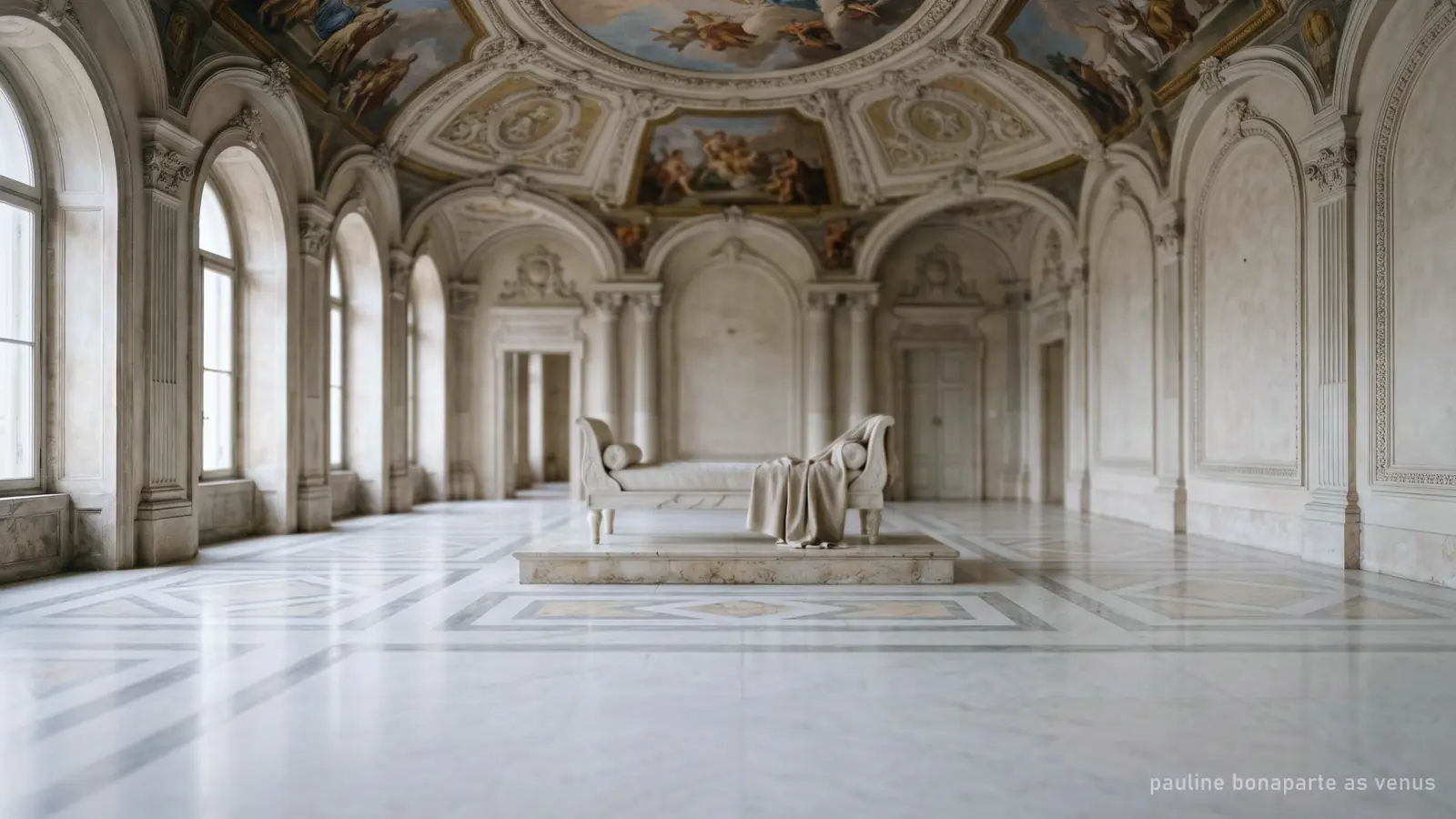
The room was chosen to fit the ceiling. Domenico de Angelis painted the Judgement of Paris there in 1779, with scenes from the stories of Venus and Aeneas around it. Before Napoleon’s purchase, the room was called the Room of the Vase, after the ancient Borghese Vase that now stands in the Louvre.
Seeing it on your visit
The Borghese Gallery admits visitors in timed two-hour slots of up to 180 people, and booking is required for every ticket. Bags larger than 21 x 15 cm go to the cloakroom first. Photos without flash are allowed.
The official ticket costs €18 (€16 + €2 booking fee), about $20, and cannot be refunded. The audio guide ticket from $44 or the guided tour from $55 add commentary in the room. Both show free cancellation up to 24 hours before on the listing. See all options on the tickets and tours page.
For the other works most visitors come for, see Canova’s Pauline Bonaparte in the Borghese Gallery and the rest of our masterpieces list, from the Berninis to the Caravaggios.
Check prices & dates
Book your tickets in advance: popular time slots sell out.
Book Borghese Tickets
From$44per person
Check availability- Free cancellation up to 24h on every ticket listed
- Reserve now, pay later
- Official price shown alongside
Frequently asked questions
Who was Pauline Bonaparte?
Napoleon's younger sister (1780-1825), born in Ajaccio, Corsica. Widowed by General Leclerc in 1802, she married the Roman prince Camillo Borghese in 1803, which is how her portrait ended up in the Borghese collection.
Did Pauline Bonaparte pose nude for Canova?
Nobody knows. Stories that she did, and joked about it, circulated at the time, but the museum calls the statue an idealised portrait, and Wikipedia notes that only the head is a realistic likeness.
Why is she holding an apple?
It is the golden apple Paris gave to Venus as the most beautiful of the goddesses. It makes her Venus Victrix, Venus the victor of the Judgement of Paris.
Where is the Pauline Bonaparte statue?
In Room 1 of the Borghese Gallery in Rome, the Pauline Room, where it has stood since 1889. The ceiling above it shows the Judgement of Paris.
Sources