
informational 5 min read
The Rape of Proserpina by Bernini at the Borghese Gallery
Updated October 27, 2026
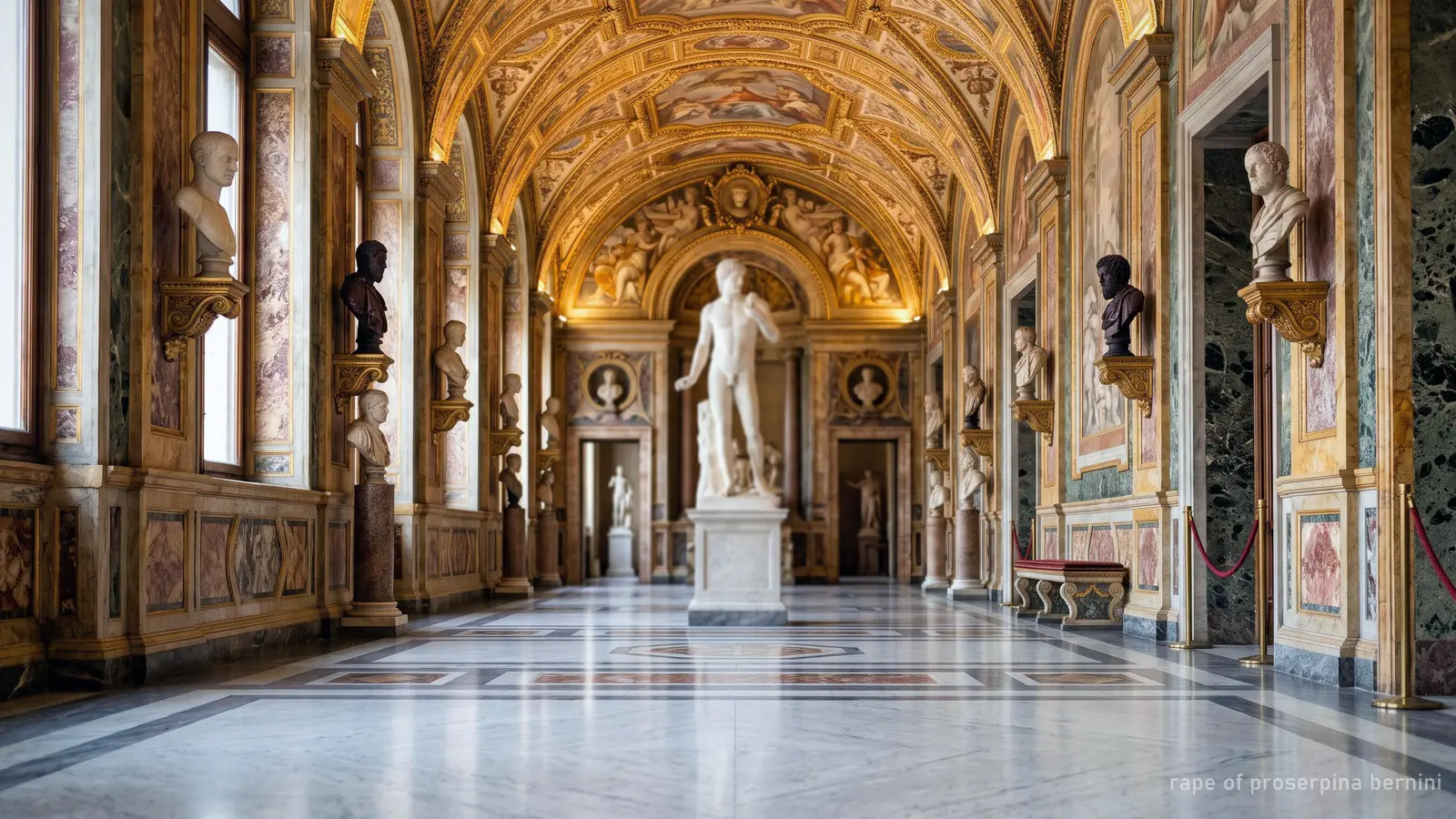
The Rape of Proserpina, more accurately “the Abduction of Proserpina”, is a marble group by Gian Lorenzo Bernini, carved in 1621 and 1622 for Cardinal Scipione Borghese. It shows Pluto, god of the underworld, carrying off Proserpina while she fights to escape, with the three-headed dog Cerberus at his feet. It is 255 cm high without its base and stands in the centre of Room 4, the Room of the Emperors, at the Borghese Gallery in Rome. Bernini was 23 when he finished it.
The myth
The story is told by the Roman poets Ovid, in Book V of the Metamorphoses, and Claudian, in The Rape of Proserpina. Proserpina, daughter of Jupiter and Ceres, goddess of the harvest, is picking flowers by Lake Pergusa near Enna, in Sicily. Pluto bursts out of the ground and drags her down to his kingdom.
Ceres, mad with grief, lets the earth dry up and the harvests fail. Jupiter steps in, and a deal is struck: Proserpina will spend half the year with her mother and half with Pluto. The myth explains the seasons. When she is below, nature dies and winter comes; when she returns, it is spring.
“Rape” here keeps its old meaning from the Latin raptus, a seizing or abduction, which is why Wikipedia prefers the translation “Abduction of Proserpina”. The Italian title is Ratto di Proserpina.
The hand on the thigh
Bernini chose the climax of the story. Pluto lifts Proserpina off the ground as she twists away, pushing against him and flinging one arm out. His fingers press into her thigh and waist, and the marble seems to give way like skin. The museum’s catalogue describes Pluto’s hands sinking into her flesh as his muscles strain to hold the struggling body.
How do you make stone look soft? Wikipedia describes Bernini using different tools for different surfaces: abrasives to smooth the skin, a chisel for foliage and a rasp for cloth. Look also at Proserpina’s face: a trickle of tears runs down her cheek.
The structure is pushed to the limit of stability, in the museum’s words. The two figures pull away from each other while both stay turned toward the viewer. Cerberus, joined to Pluto through the cloth, marks the border of the underworld and helps support the group. It may have been added only when Bernini needed the support, since his surviving sketch has no dog. That drawing is his earliest datable one and the only preparatory study known for his Borghese statues.
Unlike many statues of the time, the group is meant to be read from one main viewpoint, directly in front. From there you see both Proserpina’s despair and Pluto’s grip at once.
Bernini also looked at older models. The museum points to the ancient Borghese Gladiator, then in Scipione’s own collection, in the strong, wide stance of Pluto’s legs, and to Annibale Carracci’s ceiling in the Farnese Palace for the bodies.
Commission, gift and return
- June 1621: Scipione Borghese pays Bernini 300 scudi on account for “a statue of Pluto abducting Proserpina” and a bust of the late Pope Paul V, his uncle.
- September 1622: the white marble pedestal is finished. It carried a Latin couplet by Cardinal Maffeo Barberini, the future Pope Urban VIII, in Proserpina’s voice. In the museum’s translation: “O you who, bent to the ground, gather flowers, look at me as I am carried off to the house of cruel Dis.”
- Autumn 1622: the group leaves Bernini’s studio near Santa Maria Maggiore and, protected by a wooden frame, is taken to the Villa Ludovisi. Scipione has given it to Cardinal Ludovico Ludovisi, nephew of the new pope Gregory XV. The museum sees the gift as a response to the less favourable political climate after the election.
- Late 1800s: the Villa Ludovisi is demolished and the group goes to the new Palazzo Boncompagni Ludovisi.
- 1908: the Italian state buys it and returns it to the Borghese Gallery, in the centre of the Room of the Emperors.
- 1911: Pietro Fortunati carves the present base. The original pedestal with Barberini’s couplet is lost.
The gift explains why Apollo and Daphne exists. Wikipedia notes that the new group likely replaced the one Scipione had given away.
Where it stands
The group is in the middle of Room 4, the Room of the Emperors, also called the Gallery, on the ground floor. The room takes its name from 18 porphyry and alabaster busts of the Twelve Caesars, with some repeats and a Juno, made in the 17th century. Above them, Domenico de Angelis painted the story of the sea nymph Galatea on the vault between 1778 and 1780. Four marble vases of the seasons from 1785 stand around the room.
Seeing it on your visit
The Borghese Gallery admits visitors every hour in timed two-hour slots, up to 180 people each, and every ticket needs a booking. Room 4 is on the ground floor with Bernini’s other groups, the David in Room 2 and Apollo and Daphne in Room 3.
The official ticket costs €18 (€16 + €2 booking fee), about $20, non-refundable. A guided tour starts from $55 per person with free cancellation up to 24 hours before, and the tickets and tours page compares every option.
For the full set, see Bernini’s sculptures at the Borghese on our masterpieces page.
Check prices & dates
Book your tickets in advance: popular time slots sell out.
Book Borghese Tickets
From$44per person
Check availability- Free cancellation up to 24h on every ticket listed
- Reserve now, pay later
- Official price shown alongside
Frequently asked questions
When did Bernini make the Rape of Proserpina?
In 1621 and 1622, in about a year. Bernini was 23 when he finished it, and it was the first of his great marble groups for Cardinal Scipione Borghese.
How big is the Rape of Proserpina?
255 cm high without the base, according to the Borghese Gallery's catalogue. It is carved in white marble.
Why was it not in the Borghese collection for almost 300 years?
Scipione Borghese gave it to Cardinal Ludovico Ludovisi in 1622, after a Ludovisi pope was elected. It stayed with the Ludovisi family until the Italian state bought it in 1908 and brought it back to the Borghese Gallery.
Where is the Rape of Proserpina?
In the centre of Room 4, the Room of the Emperors, on the ground floor of the Borghese Gallery in Rome.
Sources